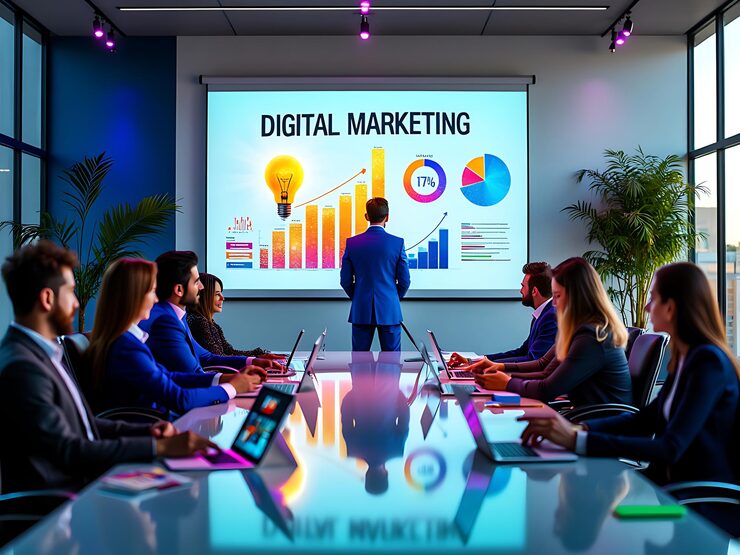
Not every path into a good career runs through writing code. As more businesses in Trichy shift their advertising budgets from newspapers and banners toward Google, Instagram, and Facebook, an entirely different kind of skill set has become just as valuable as technical development — the ability to actually market a business online.
Digital marketing has quietly become one of the more accessible, practical career paths for students and job seekers who want to build a career in the growing digital economy without necessarily becoming a programmer.
Why Every Business Suddenly Needs This Skill
A decade ago, a business’s marketing budget might have gone toward a newspaper ad or a local radio spot. Today, that same budget is far more likely to go toward search engine visibility, social media advertising, and content that actually reaches the right audience online. This shift hasn’t slowed down — if anything, it’s accelerated, as more customers research and even purchase everything from clothing to healthcare services entirely through their phones.
Businesses that don’t have this expertise in-house are actively hiring for it, which is a big part of why digital marketing roles have grown steadily even as some other job categories have stayed flat.
What Digital Marketing Actually Covers
The field is broader than most people expect before they start learning it. It typically includes search engine optimisation, which helps a business appear in search results without paying for ads; paid advertising on platforms like Google and Meta; social media marketing and content creation; email marketing; and analytics, which involves actually measuring whether any of this marketing effort is working.
Each of these areas is a specialisation in its own right, which means digital marketing offers multiple career directions rather than one narrow job title — something worth knowing before assuming the field is only about “running ads” or “posting on Instagram.”
Why This Field Suits a Wide Range of Backgrounds
Unlike more technical fields that can feel intimidating to someone without a coding background, digital marketing tends to be genuinely approachable for students from commerce, arts, and even science backgrounds. Skills like clear writing, basic analytical thinking, and creativity translate directly into effective marketing work, which is part of why the field attracts such a mixed group of learners.
This accessibility doesn’t mean the work is simple. Effective digital marketing requires real strategic thinking and constant testing — it’s just that the barrier to entry doesn’t require years of technical study before someone can start contributing meaningfully.
What a Genuinely Useful Course Should Teach
A solid program should cover search engine optimisation fundamentals, paid advertising across major platforms, social media strategy, basic content creation, email marketing, and analytics tools that let students actually measure campaign performance rather than guess at it. Real campaign practice — planning, running, and analysing an actual campaign, even a small one — matters far more than memorising platform features that change every few months anyway.
Courses that only teach theory without any hands-on platform experience tend to leave students unprepared for the reality of the job, where most of the learning happens by actually managing live campaigns and reacting to real performance data.
Why Practical, Campaign-Based Learning Matters Most
Digital marketing platforms change constantly — algorithms update, ad formats shift, and what worked last year sometimes stops working entirely. Because of this, the most valuable thing a course can teach isn’t a fixed set of steps, but the underlying thinking: how to research an audience, test different approaches, read the data honestly, and adjust based on what the numbers actually show rather than personal assumptions.
Students who complete a properly structured Digital Marketing Course in Trichy with real campaign practice tend to walk away with something more durable than platform-specific tricks — they walk away with a way of thinking about marketing problems that continues to be useful even as individual platforms evolve.
Why Certifications Alone Aren’t Enough
It’s become common for students to collect a stack of free certificates from various online platforms without ever managing a real advertising budget or analysing genuine campaign data. While these certificates aren’t worthless, employers increasingly look past the certificate itself and ask candidates to explain actual decisions — why a particular audience was targeted, why a budget was allocated a certain way, or what a specific metric in a report actually indicated.
This is exactly why hands-on, practical training carries more weight in interviews than a folder of certificates earned through passive video-watching. Being able to speak confidently about a real campaign you managed, including what didn’t work and what you changed because of it, tends to leave a far stronger impression than a list of course completions.
Career Paths Open to Digital Marketing Graduates
Graduates commonly move into roles such as digital marketing executive, social media manager, SEO specialist, paid ads specialist, or content marketer at agencies, startups, and established businesses across nearly every industry. Many eventually move into freelance work, managing marketing for multiple small businesses at once, while others progress into broader marketing management roles as their experience grows.
The range of available roles is part of what makes this such a flexible career choice — a graduate isn’t locked into one single job description.
Getting Started
If you’re weighing your career options and coding isn’t necessarily your interest, digital marketing offers a genuinely practical alternative that’s in active demand across Trichy’s growing business community. A properly taught Digital Marketing Course in Trichy that combines real platform experience with genuine strategic thinking can turn what feels like a broad, slightly abstract field into a concrete, employable skill set — one that businesses across nearly every industry are actively looking to hire for right now.